
Defining the Digital Workplace
Enabling the future of digital work and collaboration at BC Gov.
Client Enterprise Services, Ministry of Citizen Services (CITZ), Government of British Columbia
INTRODUCTION
Enterprise Services (ES) provides the technology and information management backbone to the Government of British Columbia (BC Gov), serving over 6,000 members of the BC Public Service. Following an accelerated shift to remote and digital tools during the pandemic, ES sought to meet evolving demands and better support employees across the Public Service through the continued development of a modern digital workplace. The Digital Workplace Initiative (DWI), launched in 2021, aimed to create a seamless and sustainable digital work environment for BC Gov.
THE CHALLENGE
With the rapid adoption of remote work during the pandemic, ES faced the challenge of building a cohesive, long-term digital workplace strategy based on the new capabilities of Microsoft 365 (M365) and the expectations of Ministry clients and public service employees.
Their goal was to ensure that technology investments aligned with the broader vision of a modern, collaborative, and efficient workplace for the Public Service.
This required a common understanding of the needs and desires for the future of digital work at BC Gov.
CREATING A VISION
Spatial partnered with ES at the inception of DWI, bringing expertise in service design and strategic research to guide the process and ultimately establish the Digital Workplace and Collaboration Services (DWCS) branch within Enterprise Services.
Over several years, Spatial worked with the digital workplace team to align ES on a shared vision for the future of digital work. We helped them define a vision for a modern digital workplace, create a framework and roadmap to align technology initiatives with employee needs and organizational goals, and build internal service design capacity to sustain and evolve the transformation.
THE WORK
DWCS was established with Spatial's support and sustained collaboration in several key areas:
Strategic Research and Insights:
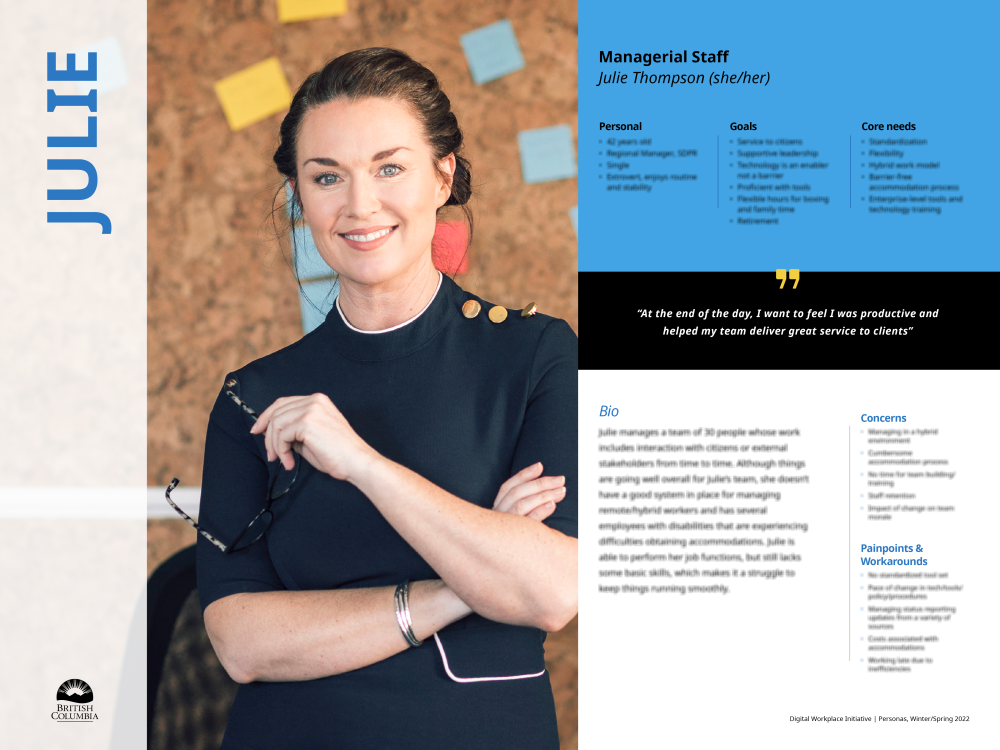
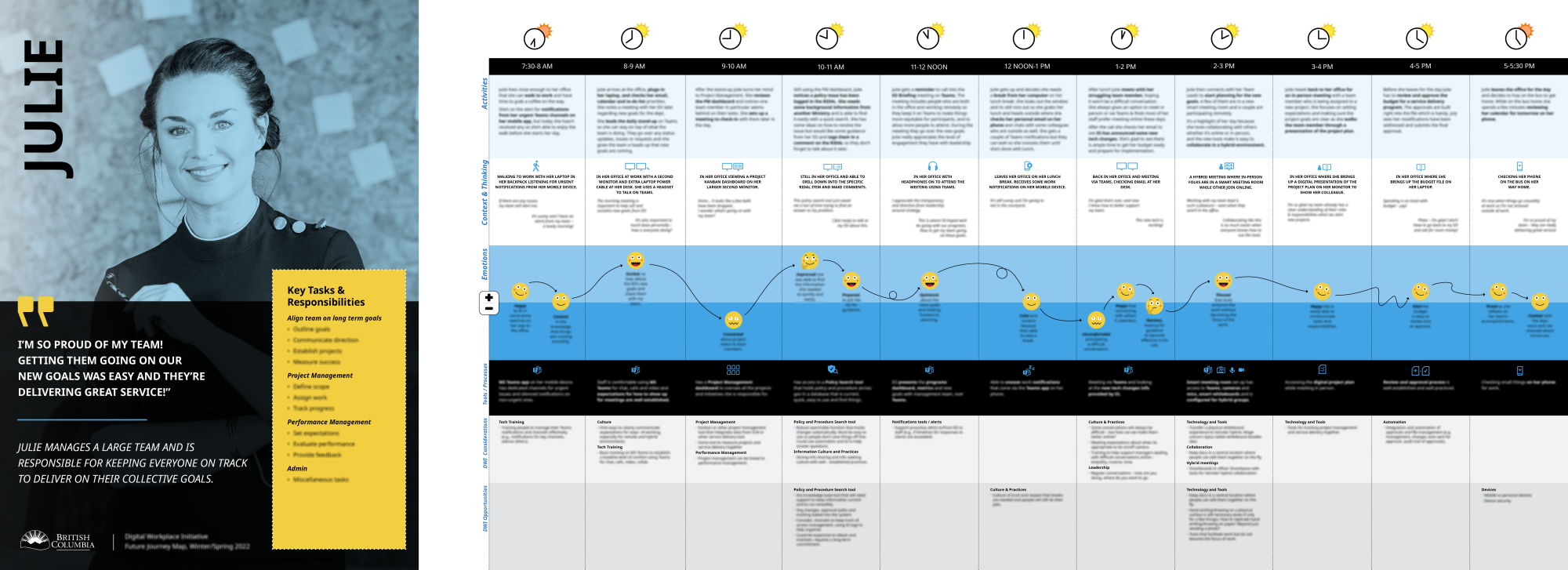
Spatial led strategic, generative research to identify employee needs, pain points, and expectations for a modern digital workplace. This research informed the creation of detailed personas and future-oriented journey maps, providing a clear shared understanding of the digital workplace vision.
Framework Co-creation:
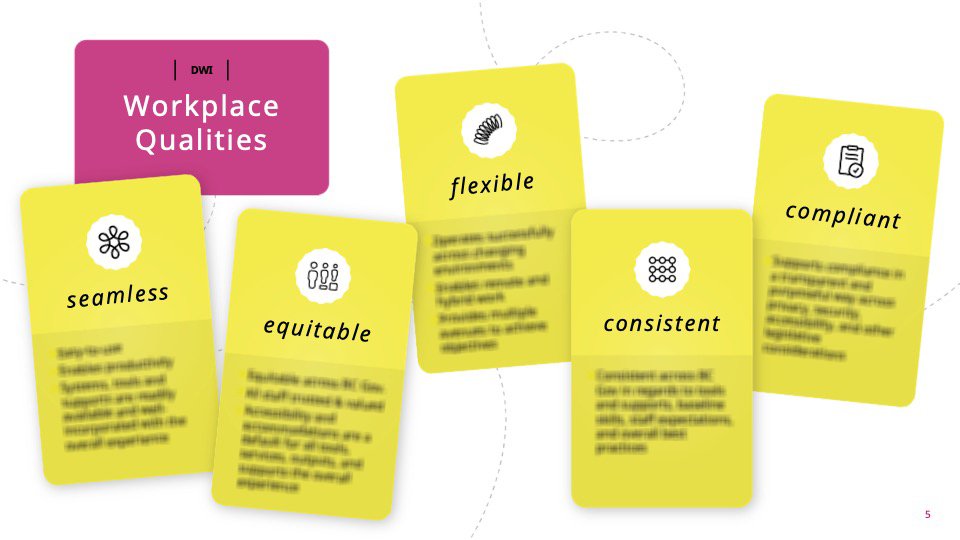
Based on the strategic research, Spatial identified five core Digital Workplace Qualities to define the desired digital workplace experience. We then developed a framework with definitions and guiding questions for each to help align technology initiatives to this experience.
Leadership Development and Capacity Building:
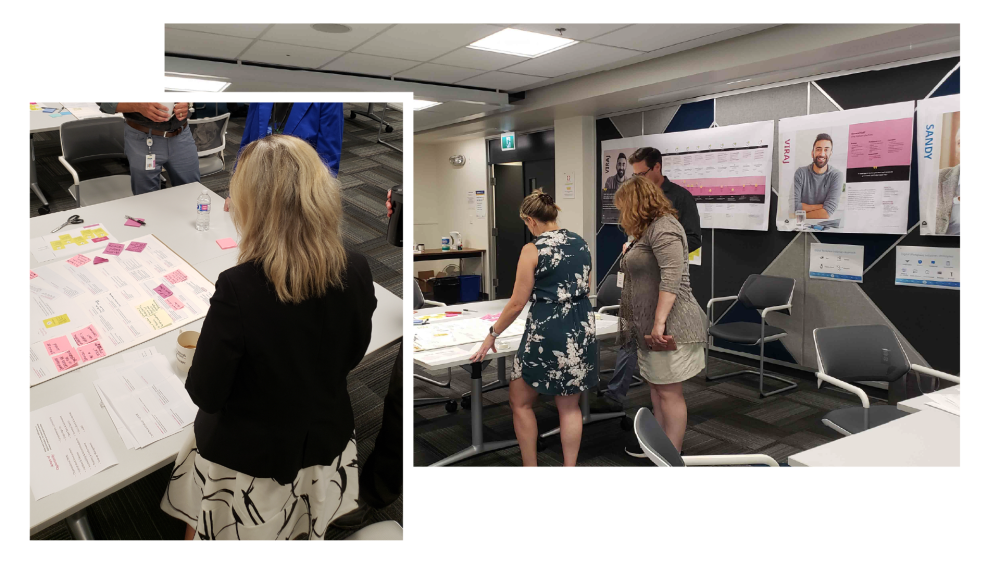
Throughout the process, Spatial provided mentoring and coaching to internal teams, fostering a culture of service design and empowering them to sustain transformation efforts. Co-creation workshops ensured alignment at every level, from strategic planning to implementation.
We worked with DWCS to design an internal brand and communications strategy to ensure employees across the public service had the support they needed to access and use new digital collaboration capabilities.
Iterative Prototyping and Implementation:
We worked on several initial prototype projects to test and refine the rollout of new M365 tools like PowerBI and Exchange Online. These iterative efforts served as examples of how to approach the rollout of new technologies in alignment with employee needs.
THE BIG IDEA
Ensuring technology investments aligned with the broader vision of a modern, collaborative, and efficient workplace for the BC Public Service.
CONCLUSION
Through sustained collaboration, Spatial helped ES transform a time of rapid change into an opportunity for meaningful innovation and the establishment of new ways of working through a modern, collaborative digital workplace that could continue to meet the evolving needs of the Public Service. Working with BC Gov’s own Service Design methodology, Spatial helped build capacity and demonstrated how principles work in action.