
AI tools for UX research
Expert insights and comparative analysis on the use of emerging tech for research practices and services
Client Spatial Team
BIG IDEA
By taking an evidence-based approach to introducing AI to research practice, Spatial explored the impact of AI tools on the work of product and service innovators.
INTRODUCTION
Artificial intelligence is rapidly transforming the fields of user experience, customer experience, and strategic research and design, offering both exciting opportunities and new challenges. This study weeds through the current hype to understand the real-world implications of AI and uncover how it influences product development and innovation.
Spatial and other consultancies provide research and design services for clients across many sectors and through various methods. While these approaches are typically human-centred, they also employ technical tools to aid the process, and the use of AI is becoming increasingly popular for this.
With this project, Spatial sought to understand the impact and value AI can bring to clients, and how best to go about implementing AI in a useful and responsible manner. Experts on AI, product development, and UX research were interviewed to understand the general thoughts, concerns, and opportunities in this space.
Insights were gathered on the current state and projected future of AI in research and design, and the focus on UX research uncovered several key areas for optimizing efficiency with AI tools.
METHODOLOGY
Following a literature review and analysis of AI tools, 60-minute, remote interviews were conducted with 8 industry experts to capture their perspectives on the topic of AI in UX.
In the human-led approach, the entire process including the research plan, discussion guide, interviews, coding, analysis, and synthesis was done by the human researchers.
In the AI-led approach, various AI tools were used to replicate the methods followed by human researchers, including literature review, writing discussion guides, conducting interviews, analyzing data, and compiling reports. The AI tools were provided with the same research brief as the human team, ensuring consistency across both approaches. Various steps of the project were handled by the most appropriate AI tools, tailored to the specific task.

KEY TAKEAWAYS
AI is a powerful tool for ideation and enhancing creativity, but it is not a replacement for human ingenuity.
AI excels in brainstorming and managing repetitive tasks, allowing UX professionals to focus on higher-level creativity and innovation; however, its effectiveness still relies heavily on human oversight for strategic direction and critical thinking.
The future of UX with AI will centre around human-AI collaboration, with professionals guiding the "what" and "why" of product development.
While AI automates routine tasks, UX experts will ensure meaningful, human-centred experiences. The future is likely to see a shift toward more dynamic, intuitive, and multimodal interfaces beyond traditional text-based models.
AI amplifies existing ethical challenges and introduces new ones, requiring vigilant oversight and critical thinking.
AI's outputs can be skewed by inherent biases in training data, potentially perpetuating stereotypes or limited perspectives. And issues such as deep fakes, misinformation, job displacement, and environmental impact are real concerns regarding AI's influence.
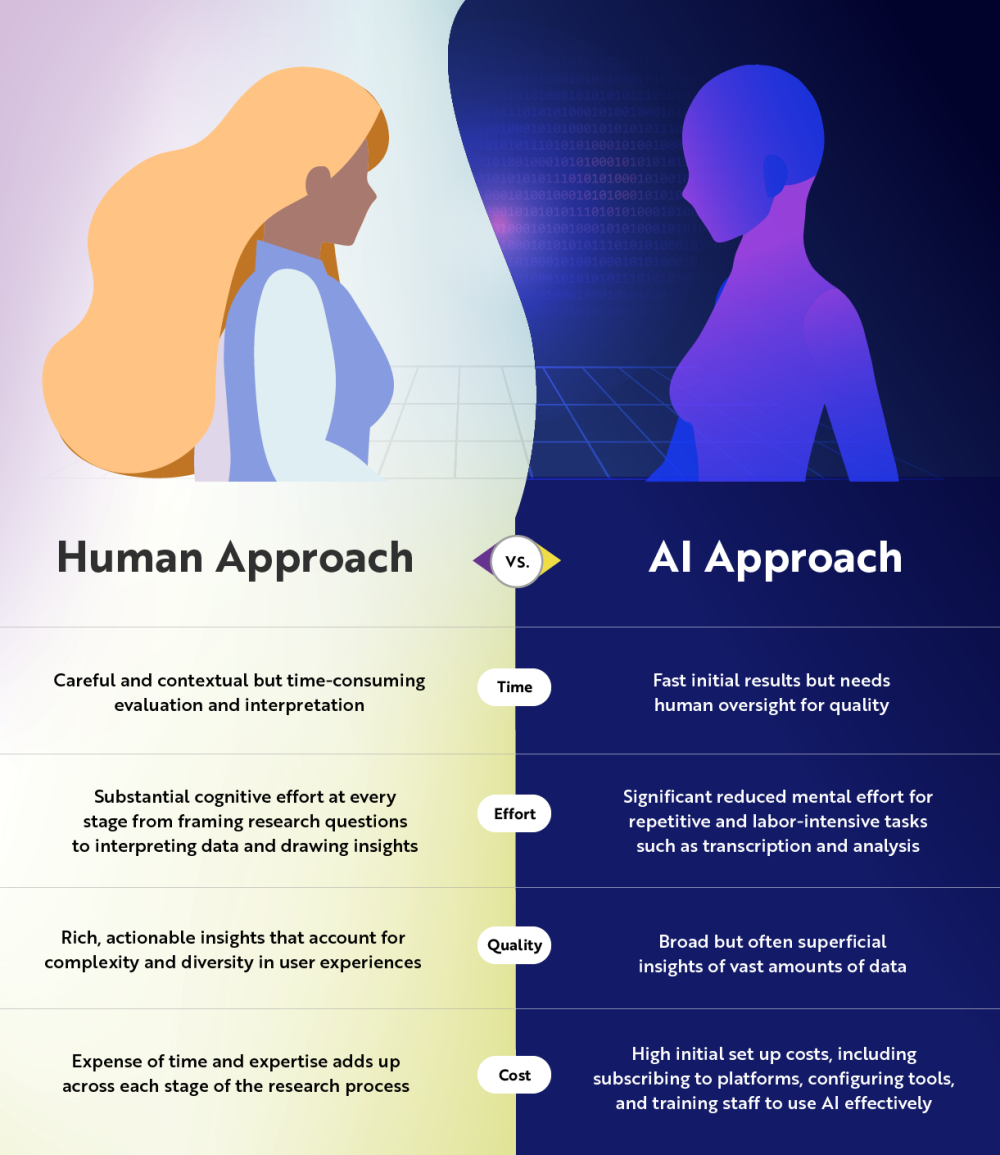
COMPARISON OF AI VS HUMAN APPROACHES
A hybrid model combining AI's efficiency with human expertise offers the most comprehensive and impactful approach.
Human researchers are crucial for strategically guiding AI through well-crafted prompts, ensuring quality, accuracy, and alignment with project objectives. This approach helps deliver insights that are not only comprehensive but also tailored to stakeholder needs.
Human Approach
Time
Humans carefully evaluate, interpret, and understand the context, which is a more time-consuming process.
Effort
Human researchers need to invest substantial cognitive effort into every stage of the research process, from framing the research questions to analyzing data and drawing insights.
Quality
The quality of human-led research is typically higher in terms of delivering rich, actionable insights that account for complexity and diversity in user experiences.
Cost
The major expense in human-led research comes from the time and expertise needed for every stage of the research process, which adds up over time.
AI Approach
Time
Although faster in comparison to the UXR approach, AI needs high human oversight for quality of results.
Effort
AI significantly reduces the mental effort required for repetitive and labor-intensive tasks such as data transcription, data analysis, and sorting through large datasets.
Quality
AI can quickly generate insights by processing vast amounts of data, but these insights tend to be more superficial or broad.
Cost
The initial costs of setting up AI tools can be relatively high. This includes purchasing or subscribing to AI platforms, configuring the tools, and possibly training staff to use the AI effectively.
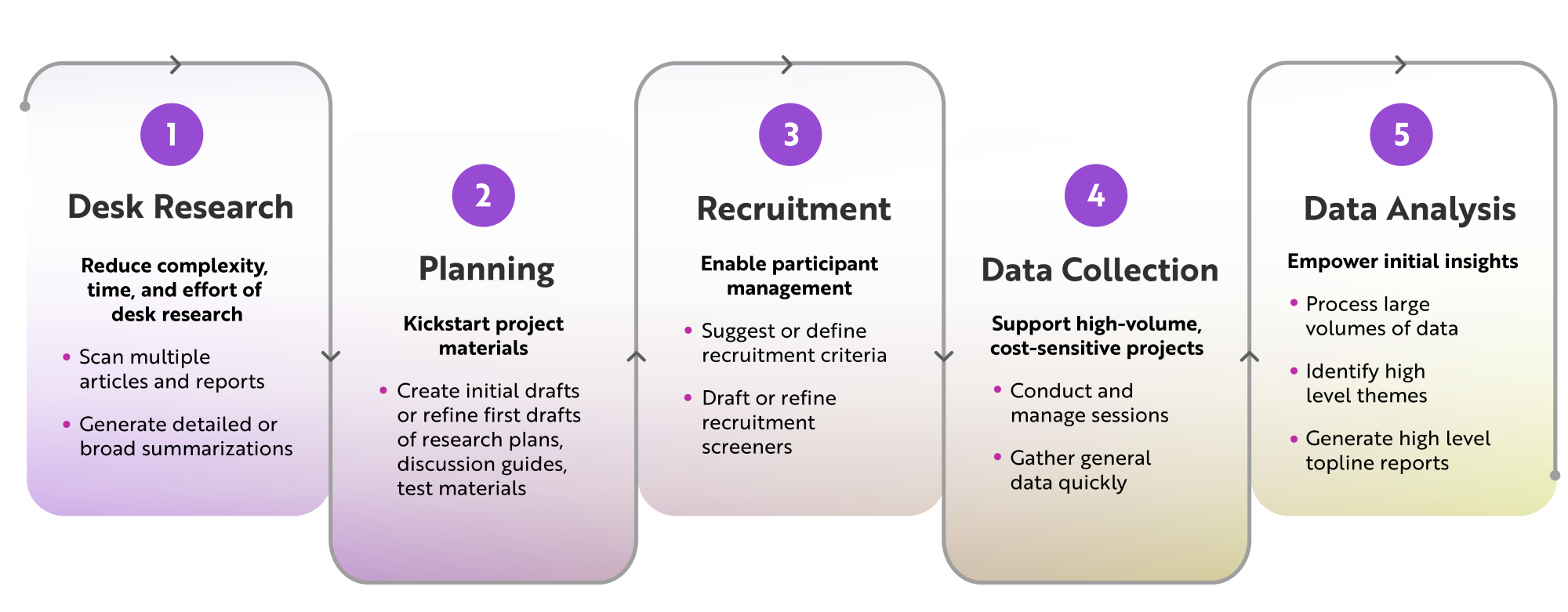
OPPORTUNITIES FOR AI IN UXR
AI-generated content differs significantly from human-created work, each with its own strengths and limitations.
AI tends to provide broader, conceptual overviews, while human-generated outputs often focus more on practical application and context-specific insights. Human analysis excels in nuanced, in-depth thinking, whereas AI analysis is broader but may lack depth in complex reasoning.
SUGGESTED AREAS FOR AI IN UXR
1. Desk Research
AI is great tool to help scan multiple articles and reports.
It can generate detailed or broad summarization on request and speed up secondary research.
It can help reduce complexity and summarize concepts.
2. Planning
AI can help with initial drafts or refining first drafts of research plans, discussion guides, and test materials.
However, the AI outputs need to be further checked and reviewed based on:
- Project contexts
- Comparative analysis of human vs AI approaches
- Resource constraints
- Stakeholder requirements
3. Recruitment
AI can help to create and refine recruitment requirements and screeners.
4. Data Collection
In projects with a high volume of participants, where manual moderation would be time-consuming and resource-intensive, AI can conduct and manage multiple sessions at once.
For projects with limited budgets or where cost efficiency is a priority, AI can provide an economical solution for data collection.
Where broad and surface-level insights are needed, AI can gather general data quickly, which human researchers can later analyze or follow up on in more detailed sessions.
5. Data Analysis
AI is great in helping researchers process large volumes of data and generate high level themes.
AI can be leveraged for quick topline reports.
AI can analyze data much faster than human researcher, making it ideal for time sensitive projects.
IN SUMMARY
AI tools are advancing rapidly and will likely provide more and better services for UX, but the experiential input of humans will still be needed. As such, Spatial is actively evolving practices to include AI, while also empowering researchers and designers to flex their expertise in its implementation.