

As a collaborative and innovation-focused R&D process – and a solid investment in your company’s ability to innovate successfully – design thinking continues to deliver value. Here’s how.
One of the biggest challenges for innovation managers – or anyone designing new products, services or systems – is knowing which ideas to select and pursue when innovating on the organization’s offerings. Ideas and possibilities are often plentiful, and many people assume that their years of experience or depth of specialized knowledge in a sector equates to an understanding of what customers really want. But research has shown that one of the top reasons new products fail is because they don’t adequately meet market needs. And history is littered with products and services that simply didn’t connect with the target market.
Design thinking casts intuition aside and anchors decision-making in evidence and understanding. Rooted in research, exploration and empathy, it’s a collaborative process that starts by defining strategic goals, thoroughly maps out customer needs and their jobs to be done, and matches up viable ideas with market opportunities. But ever since design thinking hit the mainstream a decade or so ago, it’s received as much criticism as it has accolades. And perhaps that’s partly because balancing the opinions of internal stakeholders with the needs of external end users can be more costly and time intensive than simply relying on intuition and industry experience when going to market with new products or services.
We’ve worked with a wide variety of teams – from scientific researchers to IT labs to government branches – to help define and develop products, services and applications. Our research and development process is rooted in design thinking because we’ve seen the opportunities, impact and competitive advantage that come from thoroughly understanding the customer’s needs, accurately defining the goal and uncovering the market opportunities that offer the most potential – even if they’re different from what was originally envisioned.
Here’s why we believe design thinking processes are still the best way to solve complex problems and launch (or refine) successful products and services.
DESIGN THINKING IS ROOTED IN LONG-TERM VALUE
Many companies launch new products and service offerings based on the appeal of new tools and technologies. Just look at what’s happening right now with AI – organizations big and small are scrambling to find ways to integrate Chat GPT-like offerings into their products. And we’ve seen this scenario play out time and time again: advances in technology are adopted by competitors or customers, prompting clients to integrate them into their own offerings without much investigation as to their actual value or reflection on customer needs.
Of course, failing to innovate is also a major concern for organizations, because it risks alienating customers by not keeping up with the times. But just as being slow to evolve can sink a company, so too can innovating too quickly without backing up the change with research and a thorough understanding of the market’s needs.
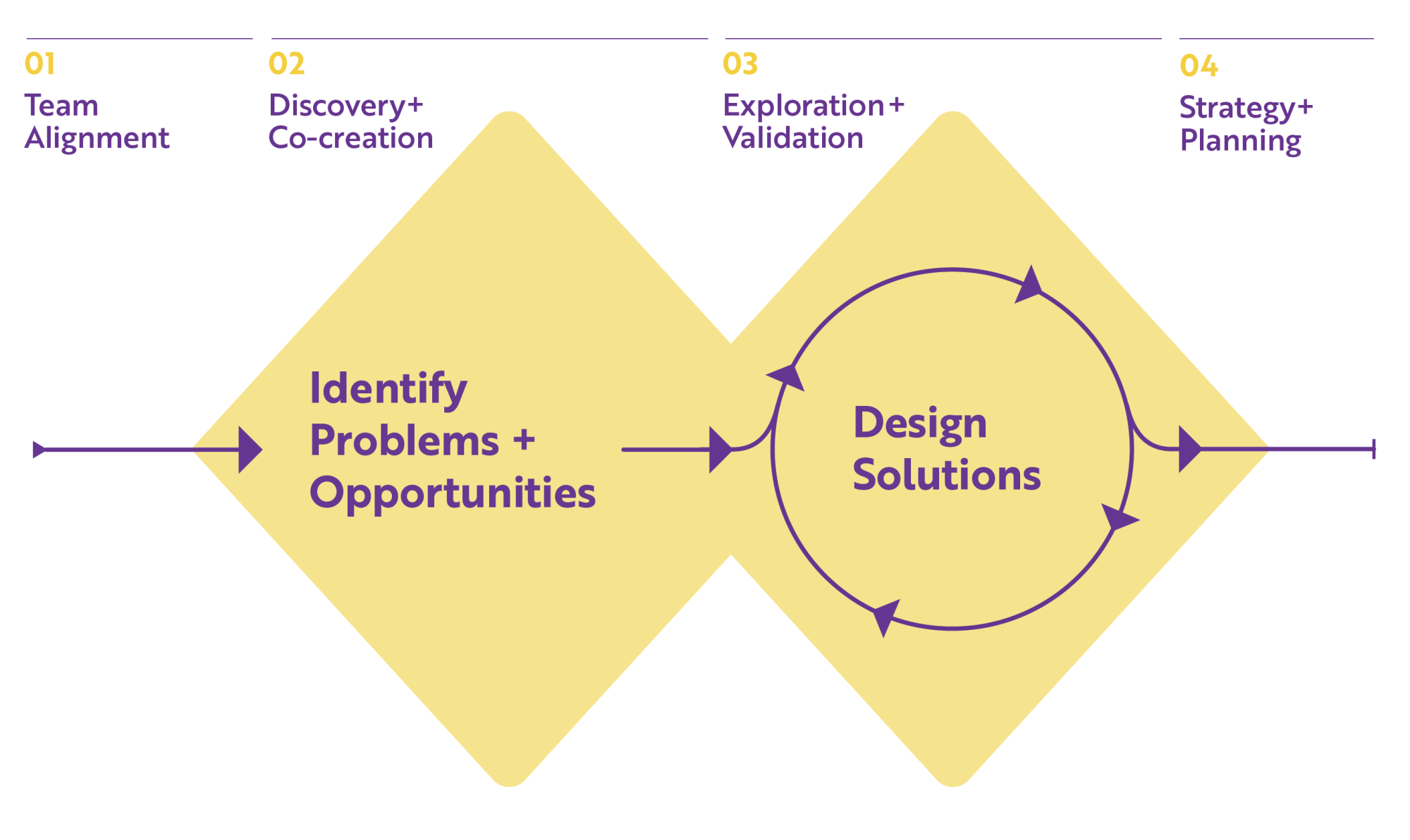
Design thinking puts assumptions aside in favour of thorough investigation and evidence-based strategic planning. It’s essentially a structured way of brainstorming, generating ideas, considering different angles, validating assumptions with prototyping and testing, and encouraging innovative thinking – all with the purpose of achieving a specific goal that is rooted in a solid business case. It’s not about introducing new tech because competitors are doing so, but adding features, products or services that represent a proven market opportunity or an improvement in the customer experience.
And the beauty of the process is that it often uncovers opportunities you might not even have considered, driving value for years to come.
DESIGN THINKING MAKES INNOVATION A TEAM EFFORT
We live and work in a world that is hyper connected, and yet innovation often still happens in silos. This can impede the strength and diversity of ideas, not to mention team buy-in.
Design thinking integrates collaboration into the process of innovation, so that cross-functional teams have the opportunity to share and build on their experiences and ideas, capture requirements within a shared contextual framework, and establish priorities that bring real value for everyone involved.
Our R&D process brings cross-functional teams together to ensure all stakeholders are aligned on the vision for the project and can and work in parallel on development and execution. Sure, it can take longer to get everyone aligned, but the cost of not doing this work upfront can result in challenges with the outcome – and with long-term implementation. Working collaboratively can expose gaps in knowledge about customer journeys and behaviours that may otherwise have led to poor decisions.
Sometimes the design thinking process can result in new external connections that drive interest in the end-product. Such was the case with one of our public sector clients, who, by bringing together external stakeholders from a variety of industries, academia, government and First Nations groups during its research process, was able to develop a built-in community of interest for its new venture.
Eschewing design thinking in favour of speed to market eats into all of the benefits that come from strengthening collaboration, and can ultimately undermine your efforts to innovate.

DESIGN THINKING IS A STRATEGIC INVESTMENT
Any new product or service launch represents a business risk. But smart businesses mitigate the risks with strategic planning – and design thinking fits beautifully into this process. We like to think of design thinking as a strategic investment that reduces the risk of innovation, and increases the potential for success. And studies bear it out.
McKinsey revealed that companies that invest in design thinking processes see one-third higher revenue growth and 56% higher overall growth over a five-year period than their industry counterparts.
And we’ve seen it with our clients, too. For example, our design thinking process with the YWCA Metro Vancouver, paired with human-centred information design and a strategic design approach, resulted in a new website that drove a 28% increase in page views, a 17% increase in time on page, and a 2.5% decrease in bounce rate after its launch.
While the payoff may not always be instant, design thinking is an investment in the future of both the company, and customer success – as long as it’s backed up by a corporate structure, skills and experience that enable teams to make the best use of the methodology. In a rapidly changing business context, increasing your chances of success by validating proposed ideas and approaches before going to market is one of the best ways to ensure a return on your investment. That’s just smart business.