
Part 2: Learning to Love Agile
In my last article, Part 1: Top 5 Pain Points about Agile for Researchers and Designers, I ranted about why it’s hard to love agile as a UX researcher or designer.
While I want to love agile, in so many ‘Agilesque’ environments, the pain points for UX teams include a lack of compelling vision to guide the team, disconnection between backlog prioritization and what adds value to customers, principles that are nice in theory but not realistic in practice, and a limited view of what success looks like.
In this article, rather than just rant about what doesn’t work about Agile from a Research and Design perspective, I’m going to share our thinking on how we move past these challenges and learn to love agile.
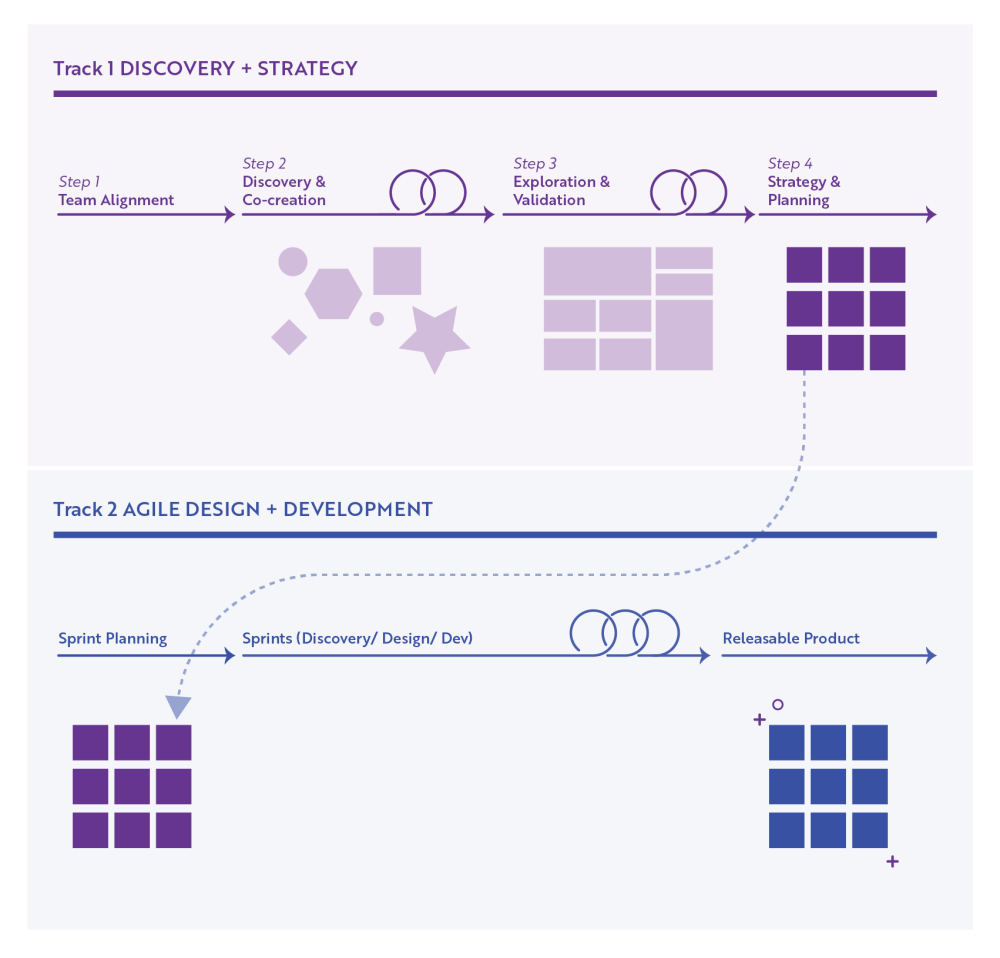
An approach that resonates is what Danny Vigil calls Dual Track Agile.(1) As the name implies, the approach has two tracks: the first track is Discovery, where product strategy happens, supported by research and design; and the second track is Design + Development, where a defined methodology is used (i.e. Scrum or Kanban) and teams include UX inputs and testing as part of sprints.
We have adapted Vigil’s Dual Track Agile approach to align with our design thinking methodology and approach to working with agile teams, and this is reflected in Image 1 below.
Image 1: Spatial’s Two-Track Agile Design Methodology
.............
(1) “Dual Track Agile: Level Up Enterprise Product Design with UX”
Track 1: Discovery and Strategy
The first track establishes a product vision and digital strategy that is grounded in research and that aligns all stakeholders and team members on what is most important for customers. For new products or transformation projects, this step is fundamental to success.
Spatial uses a design thinking methodology that is human centred, collaborative and delivers actionable outputs. Done well, design thinking creates a strong foundation that sets teams up for success.
For established products, this strategic first track may not be needed. The litmus test is:
- The product should be clear on the customer problems it is solving
- It should have a well-articulated vision and mission
- The product backlog ties priorities back to achieving the vision and customer-focused outcomes
With an established product, at a minimum, the product manager should be able to articulate the vision and describe the target audience and product proposition. Existing customer data and product performance analytics can be used to demonstrate and track product progress towards achieving its mission.
The main point is that in an agile context, all members of the team should understand the product vision, expectations of the team in terms of success criteria, target audience profiles, use cases, usage scenarios, user journeys, requirements, etc.
Also, even well-established products should undertake big picture thinking and strategic planning regularly, ideally yearly, to innovate and address changing market expectations and competitive pressures. Agile dev environments may be more nimble and adept at changing to market needs, but may miss the boat on new innovation or be at risk of reacting to market forces rather than anticipating and pivoting.
Track 2: Agile Design and Development
The second track is Agile Design + Development, where a defined agile methodology is used (i.e. Scrum or Kanban) and teams include UX inputs and testing as part of sprints.
Firstly, let me just note that many UX designers and researchers have not had training in agile principles and methodologies. And often agile developers may have little experience working with UX designers and researchers. So for anyone joining an agile team, ensure you are clear on the product lead’s expectations of your role, and how agile is practiced in their organization.
Product teams need to recognize that user experience and user interfaces (UX/UI) evolve from concepts to tested design outputs. Depending on the product needs, the team should agree on what outputs are best and what ‘done’ looks like. This could change as product development progresses.
A design output could be simple wireframe concept or journey map that allows a team to test assumptions, uncover constraints or help to answer technical questions; it could be adding a feature in which case the outputs could be a prototype of interface changes for testing; it could be introducing a new design, in which case outputs could be a prototype or annotated wireframes, page mockups, style guide, etc.
I’ve worked on projects where early-stage design concepts are implemented by developers who then get frustrated when the design keeps changing. This shouldn’t happen.
Summary
Some of the biggest challenges of bringing UX research and design to an agile development environment can be solved using a two-track methodology.
All products need and benefit from strong strategic fundamentals which include developing a deep understanding of the audience and a well-articulated vision of what a successful product will deliver in terms of value.
Since a key principle of agile software development is delivering customer value, bringing UX and research into the process should lead to better products that meets the needs and expectations of the target audience. They key is setting the team up for success with clear communication about what needs to get done at what point and why.