
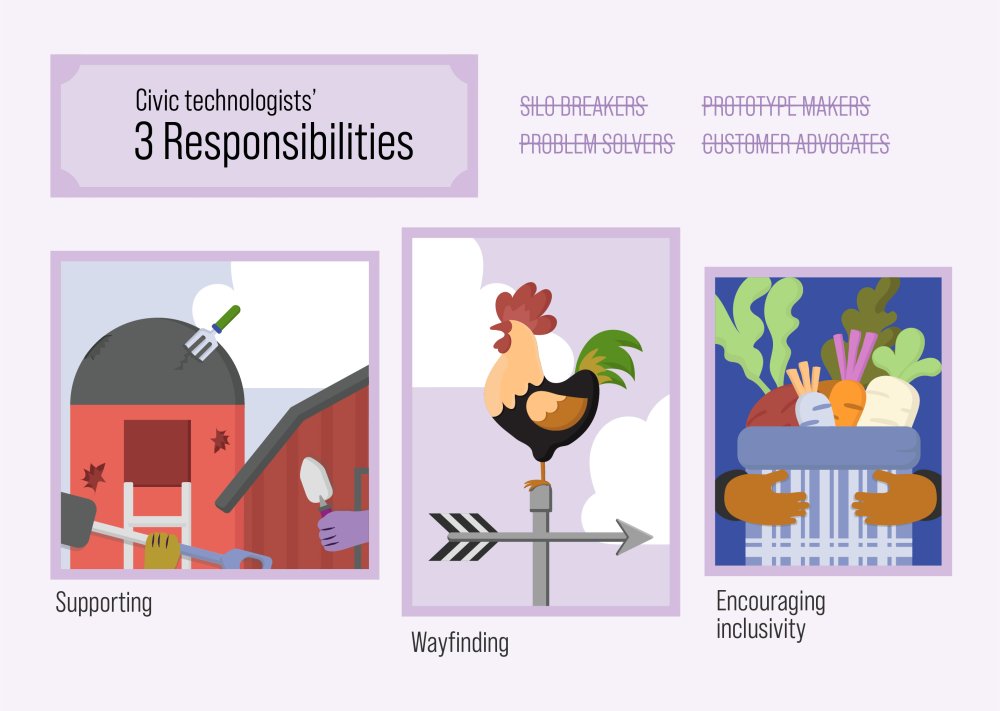
Many user experience (UX) and service designers see themselves as problem solvers, silo breakers, customer advocates and prototype makers. And for those of us working with government, we often come into projects aspiring to have social impact.
However, the reality is, there can be a huge gap between our expectation of what our role is as a designer, and our day-to-day practice working with government. In my own experience, I’ve often felt stuck and frustrated, like walking in a swamp.
What prompted me to see things differently was a quote from Cyd Harrell’s book, A Civic Technologist's Practice Guide, which is worth sharing. She says,
“Our job as civic technologists isn’t to be the hero of the stories we stumble into halfway through; it’s to understand and support the people who have already been in the place doing the work and who want to use tech to make improvements.”
This really resonated with me and I realized that I was hung up on my perception of a designer’s “role” rather than the “true responsibility” of supporting and understanding. With this revelation, the negative feeling of being stuck started lifting. I found that if I repositioned myself as a civic technologist, the real role of design can be encapsulated in these 3 responsibilities:
- Supporting: Think and act like a supporter rather than a problem solver. With digital transformation projects, civil servants often face complex challenges, and we are here to help them tackle those challenges and better understand the bigger picture context for change. Sometimes we are trying to understand the problem, not provide the immediate solution.
- Wayfinding: We don't have to know all the answers and deal with all the moving parts at once. We only need to know how to find a way out by asking the right questions and proposing direction.
- Encouraging inclusivity: Through research and design we can incorporate diverse perspectives including those of marginalized groups, so that government services support all audience groups in more balanced, equitable ways.
Image: Civic technologist's 3 Responsibilities
What does this look like in practice?
In a recent project with British Columbia Government, I was the UX designer/researcher on an agile team that had a goal of creating websites for three advisory bodies focused on wildlife conservation in BC, all within a 3-month timeline. A primary goal was to explore a new way of collaborating with Indigenous communities and empower the First Nations advisory team to tell their story of wildlife conservation from an Indigenous perspective.
Our project partners were new to digital services, that is, they had very limited resources and knowledge of how to create good website experiences. Thinking about this from the role of a designer, I didn’t think it would be possible to design three sites from scratch within three months, following an inclusive design practice and balancing the dynamic between collaborators in the government.
But don’t panic, remember, I’m here to support!
Design Responsibilities in Practice
UX support involved research, workshops and design direction.
“Conservation is not only about species, it's a conversation about culture.” –– Indigenous representative. This perspective influenced the approach to content creation, which incorporated the work, stories and knowledge on BC wildlife conservation from Indigenous communities. The design of community engagement features also took on board a test and learn approach, starting with a conversation about selected topics but with the objective of potentially having a moderated forum to allow public engagement.
We set up foundations for a ‘minimum viable product’ (MVP) website user experience and user interface (UX/UI) structure including: defining primary users, establishing information architecture, providing a range of UX components for various use cases, and creating a ‘politically neutral’ and consistent look and feel for both government and indigenous sites.
We also provided content management training to help the partners better understand the content and operational aspects of getting a site live and then maintaining it.
Conclusion
In the words of Audrey Tang, Digital Minister of Taiwan and one of the World's 100 Most Influential People in Digital Government: "As civic technologists, we are civil servants' servants."
As designers and researchers, we expect our role to be solving problems and demonstrating value, but a lot of our work with/in government will be affected by democratic purpose and political uncertainty, and social impact might not be seen immediately. However, we can have impact and find meaning in our work, if we can focus not on our preconceived role as designers, but our responsibilities to support civil servants achieve their goals and provide them tools to break silos consistently together.